
So, friends, what’s the very first thing we do when Ma Durga sails back to her abode? (Yes, I know it’s a cruelly timed question!) But for a Bengali, the answer is a no-brainer. We immediately google the next puja (or pujo) dates. Will it be September-end? Early October? And heaven forbid, if it drifts into mid-October… that’s a heartbreak in itself! Worse still, what if we miss out on a Sunday?
Truth is, Bengalis don’t count years by calendars but by Pujo. Before Puja and After Puja are our very own BC and AD. Because for anyone with roots in the “sweetest part” of India, Bengal, life simply swings between one Pujo and the next.
Durga Puja is not just a festival — it’s the Olympics, FIFA World Cup, IPL Final, and your best friend’s wedding all rolled into one — with better food and fewer advertisements.
For five glorious days, we declare a truce with the ticking clock. Those pesky timepieces that normally dictate our every move! They can take a break. For these days, we are not mere mortals — we are Vijay Dinanath Chauhan, Rahul Khanna, and Raj Malhotra wrapped into one glorious, over-the-top Bollywood montage.
Try explaining Durga Puja to someone who’s never strolled through a pandal-lit Kolkata night, with a plate of roadside ghugni (generously blessed with chopped onions), a glass of rainbow-colored sorbot in hand, and a double egg-double chicken roll gripped like a baton in a relay race between pandals. You can’t. It’s like explaining the plot of a Satyajit Ray film using emojis — noble, but doomed to fail.
By evening, your feet surrender, and your soul signs up as some unpaid backup vocalist at an obscure para orchestra night, ( some enthusiastic ‘Kumar’) belts out heartbreak songs with more passion than pitch.
Durga Puja is about glorious anarchy — where diets, deadlines, and decorum go out the window. There are real-life tales of job offers politely declined, transfers to Bangalore heroically dodged, all for the love of Ma Durga.
Even someone in medically-induced sleep might whisper, “Wake me up when Pujo begins.”
And who can forget our grandparents declaring — every single year — “Eita e hoyto amar sesh Pujo” (This might be my last Pujo), as if they had a standing invitation to Kailash next autumn. Spoiler alert: they’re back the next year, front row at Sindoor Khela.
The truth is simple: Bengalis don’t live by calendars. We live from Pujo to Pujo.
Every year, like clockwork, we hear that half of Kolkata is packing its bags for a Pujo vacation—hills, forests, seas—the noble excuse being to “escape the crowd.” And yet, inevitably, the same crowd resurfaces at Darjeeling Mall or on Puri beach, waving selfie sticks instead of kashphool!
I sometimes dream of a Kolkata truly deserted during Pujo—peacocks dancing on Park Street near Peter Cat, or a barking deer casually trespassing Park Circus Arsalaan on an Ashtami night. Instead, year after year, the streets are choc-a-bloc. One wonders where the masses come from when “half the city” has supposedly gone away! It’s like facing an outswinger in an overcast English morning—an eternal puzzle leaving us fumbling for answers.
For many of us who grew up in suburban towns, Durga Puja was always more than just pandal-hopping and traffic snarls. It meant a sea of kashphool (Saccharum spontaneum, for those who prefer the terrible scientific name) swaying in the school fields, a sight enough to lift our spirits even after the ignominy of a classroom “kneel down.” If Birendra Krishna Bhadra’s magical voice sets the tone for the days to come, it is the child within us that ensures the political commentator, GST expert, or H1V visa specialists in us to take a back seat. For a few fleeting days, Pujo allows the original “you” to surface—wide-eyed, nostalgic, and unburdened.
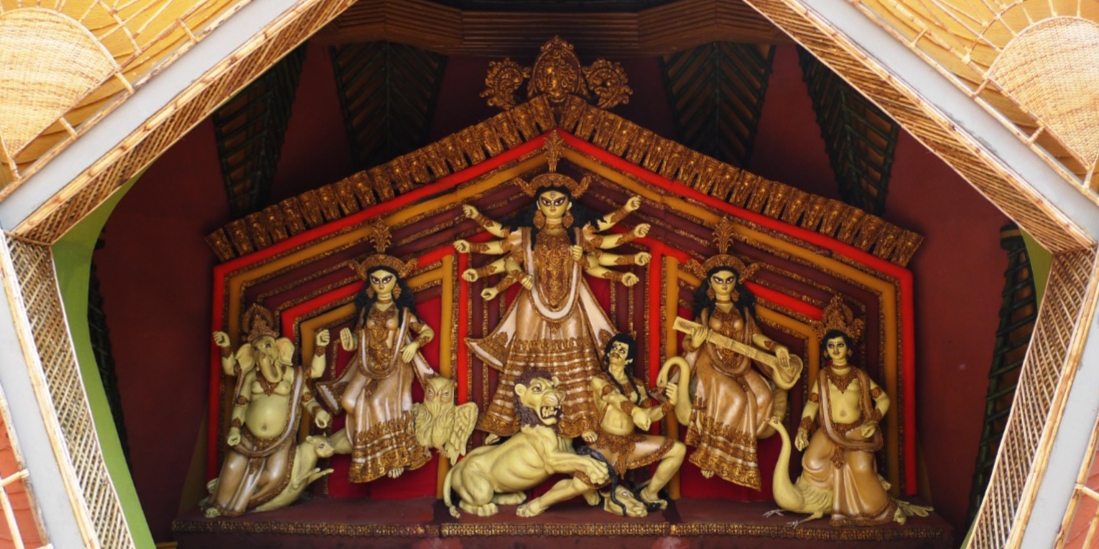
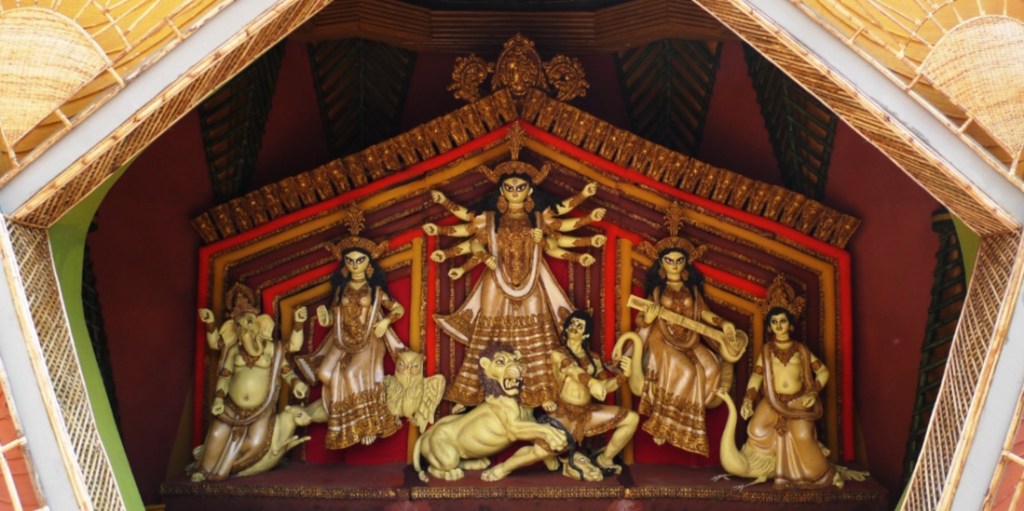
From Shoshti onwards, a strange déjà vu sets in. Each asur at the puja pandal seems to carry a familiar face—be it the recovery agent from that private bank who’s hounded you all year, the family physician who mercilessly banished red meat from your diet, or that boss who finds fresh ways to dismiss every ounce of good in you. For once, Devi Durga and her lion deliver long-awaited justice!
But Pujo is not only about our harmless sadism over everyday villains—it also coaxes out our benevolent best. Even the serpentine queues at liquor shops don’t dampen spirits. This is the season to stock up as if there’s no tomorrow. For many of us, Puja means adda (how surprising that this quintessential word had to wait until 2004 to enter the Oxford English Dictionary!) more than pandal-hopping. And adda comes with its own rituals: four packets of chanachur, salted cashews, bhetki fillets, chicken wings, mutton liver, and soda water lined up neatly on the table.
Saptami begins with a slow burn, undoing all the “good” things we’ve done to our diet. By Ashtami, the stage is set—you’re the “last descendant of a once-mighty emperor,” and nothing feels like a roadblock, not EMIs, not quarterly school fees, not even credit card bills. Nabami evenings, though, carry a shadow: the inevitable end is near. Dashami feels lighter—you’ve faced the worst, Ma is leaving, and acceptance has arrived.
And yet, beneath the rumblings and indulgence, Durga Puja stands for something larger: a togetherness we grew up with as children. The azaan at dawn, the church bells at midnight, the Sikh procession on Nanak Jayanti—all seem to find their place within Pujo. Where else would you find one of the biggest draws at Mohammed Ali Park, Catholics in puja committees, turbaned Sikhs at the immersion, all seamlessly woven into the same festival? Durga Puja is less religion, more carnival. Perhaps even the Goddess prefers it that way.
So when Ashraf plays the dhaak one last time in the fading light of Dashami, when Francis in the immersion truck ensures a steady stream of dhuno smoke from coconut husks, and when Chatterjees and Banerjees recreate Mithun’s magic alongside Agarwals and Sharmas, you realize what the Goddess leaves behind in her brief five-day stay:
That ineffable feeling of oneness.
Tell me—where else in the world would you find a festival, supposedly religious, so indulgent, so democratic, and so full of camaraderie? It is a legacy. The least we can do is pass it on, unblemished, to the next generation.
And so, as always—Dugga Dugga.
Picture courtesy: Anindya Chakraborty
 Dabbler's Diary
Indeed another very heart warming blog, that too on Durga Puja which is so close to our hearts. Love the subtle observations which you portrayed in your writing, very much Rajib da like. Keep them coming and we will keep engrossed!
LikeLike
Thanks for the kindness to use your photograph.
LikeLike
Beautifully penned…loved the spontaneity of that saccharum as I put myself into similar early days of sub urban life; while reading this, had a nostalgic longing for the early beginning of celebrations with rehearsals…will wait for the next to come Rajib da…
LikeLike
Lovely write Rajib. Osadharon. Love to read every bit of it, twice .
LikeLike
So wonderfully written, Rajib – thx for such a lovely Puja treat. I had read this piece earlier; but I believe I enjoyed it more the second time – when I could empathize with the change in mood from Saptami to Navami, and subsequently Dashami. And, more than anything else, I feel your last paragraph captures the true essence of the Pujas – it may have originated as a religious festival but is actually a celebration of human spirit and togetherness.
Wishing you all the very best and looking forward to more such enjoyable write-ups in future.
LikeLike