
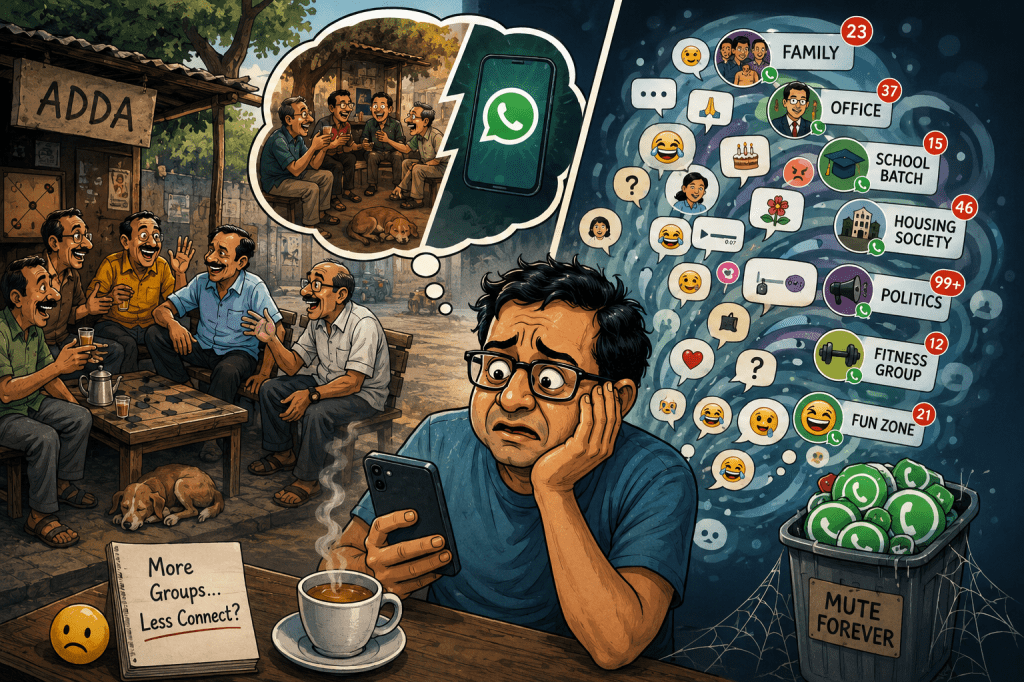
Have you ever counted how many WhatsApp groups rest peacefully inside your mobile phone? No clue? I too had no clue until the day I scrolled down to count them. I counted one hundred and twenty-eight, and then thought it wise to guzzle down the tea which, by then, had developed a thin layer on top!
One hundred and twenty-eight!
If someone as ordinary as me has 128 groups lined up in sequence, I dare not ask others about their group affiliations. Of course, one is aware that all groups are neither active nor relevant anymore, but they remain with us as reminders of a time when they mattered — when we kept returning to them again and again.
There was a time, not so long ago, when the Bengali middle class frequently visited the ‘thek’ — usually some obscure corner like a roadside tea stall, cemented para benches more popularly known as the rawk, or local clubs proudly flaunting a carrom board (match board as said) — for spontaneous and informal social gatherings lovingly summed up by the simple Bengali word: adda.
Those addas usually revolved around weighty matters: where Ronald Reagan went wrong with excessive military spending or by selling F-16 fighter jets to Pakistan; why Perestroika and Glasnost under Gorbachev accelerated the collapse of the USSR; or why Zia-ul-Haq should never have allowed that mysterious crate of mangoes to travel with him aboard the ill-fated aircraft.
Most such addas remained inconclusive, as people eventually hurried home fearing domestic backlash if dinner got delayed any further. Life was as simple as a round roti, and the theks functioned like an analog social network.
Gone are those days now.
Most of us struggle through days that stubbornly remain only twenty-four hours long, despite the endless list of peripheral activities modern life demands. The day often begins with gulping down a Pantoprazole tablet before the daily run begins. We keep running all day, yet cholesterol and triglycerides refuse to be tamed. Everyone runs, but nobody seems to arrive anywhere.
Perhaps we are missing something while running.
Amidst all this, we miss the connect. The dots no longer join. The old theks of yesteryear now wear a ghostly look. There is a strange numbness in the air even though the world has become digital. SMS groups were limited, email groups were slow, and internet forums lacked intimacy — until group communication was revolutionised by WhatsApp.
Soon, WhatsApp groups became digital versions of family living rooms, office discussions, political circles, school reunions, and neighbourhood addas.
In short, a digital thek.
We all have groups where we genuinely love to belong. Groups we created ourselves and proudly administer. Then there are groups where we remain passive throughout, silently standing and staring. Some groups forcibly adopt us, and we swallow their content like quinine. There are groups we wish to leave every single day but cannot. Some we leave, only to remain endlessly curious about afterwards.
There are groups where fierce Battles of Plassey are fought — where we register protests, dramatically exit, and are quickly added back for another war ahead. Some groups make us complete misfits, yet we continue hanging around. And then there are groups meant purely for endless banter and fun.
Every group has its own flavour.
A ping from the office group during weekends or holidays can instantly spoil the mood, while banter in a school group suddenly brings back the smell of freshly cut grass from the school ground, fading memories of muddy shoes and unfinished football matches.
And then come the family groups.
They will never allow you to forget a birthday, anniversary, ritual, or upcoming occasion. In general, though, groups are fun places to be in, they reveal layers of human character we may never have otherwise noticed.
Take, for instance, the WhatsApp group of my housing society.
Mr. Shukla posts a Lord Tennyson quote with a “Good Morning” wish. Mr. Desai counters it with Keynes’ theory of Marginal Propensity to Consume. Mrs. Singhania, having absolutely no clue what is going on, posts a Govinda number, only for it to be promptly deleted by the admin.
In protest, Mrs. Singhania leaves the group dramatically, only to rejoin later after much cajoling, eventually being permitted to post clips from the Kapil Sharma show.
Meanwhile, Dr. Swaminathan’s detailed post on China’s One-Child Policy receives a thumbs-up from the ever-sizzling Mrs. Sen, and Swami grins from ear to ear for the rest of the day.
In almost every group, a chosen few make the most noise. The rest remain passive, yet strangely relevant. Some appear remarkably active without writing a single word — reacting endlessly with emojis to practically every random post.
There is now an emoji for every unsaid emotion.
Very soon, emojis may well replace textbooks in schools!
Yet, with certainty, I can say this too: every one of us belongs to groups where some once-familiar voices have slowly faded away with time, eventually replaced by a brief and helpless “RIP” message.
And then, on certain lonely rain-soaked evenings, while scrolling through old chats, we suddenly meet them again.
The same spirited arguments. The same jokes. The same forwarded songs, festival wishes, political rants, midnight humour, and endless emojis. Voices once so alive, so opinionated, so impossibly present — now permanently silent.
Perhaps that is what these groups will ultimately become.
Not merely clusters of notifications, but digital memory lanes.
One day, every noisy group may fall silent. The endless banter, the battles, the laughter, the forwarded wisdom, the badly cropped photographs — all preserved like fossils of ordinary lives once lived loudly together.
The groups may remain. The messages may remain. Even the profile pictures may remain.
Only the people, one by one, will quietly go offline forever.
And through it all, the chats will stay encrypted.
Maybe because WhatsApp understands something we often forget — human conversations are far more fragile than they appear.


A highly relevant piece of writing.But we will never find deliverance from this harsh reality.
LikeLike
One day the chats will remain, but the voices behind them won’t- that thought stayed with me after reading this.
LikeLike